John Morris, Convict Charlotte 1788: three different sentences of death
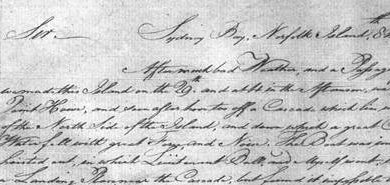
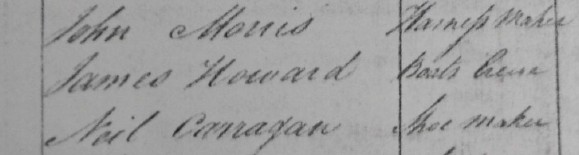
John Morris departed Norfolk Island aboard the City of Edinburgh for Hobart in Sep 1808. Two versions of the City of Edinburgh 1808 shipping manifests feature the notation that was nine unnamed delinquents (convicts) aboard the City of Edinburgh, whilst two other versions actually lists some of their names and their sentence years and other notes. Such as for John Morris who was under a colonial sentence being described as “a turbulent bad character sentenced of death has been three different times passed upon him under which he now remains”.[1]
John Morris aka John Morris Stephens, was born c1764 Hereford England. He was tried for stealing one waistcoat and other goods at Dorchester on 16 Mar 1786, age 22 years, for which he received a sentence of 7 years transportation. On 12 May 1788 he appeared before Judge Advocate’s Bench of Magistrates at Sydney Cove, over a matter of stealing a knife and waistcoat, the property of John Archer, it was decided that John Morris Stephens be dismissed from his employment of assistant overseer and to work in the same gang of which he was the overseer. Morris received 25 lashes of a 50 lash sentence on 14 Feb 1789 for repeated idleness. Then on 16 Feb 1789 he was ordered to pay the value of a fowl, which he had killed, the property of William Thompson. [2]
John Morris departed the Colony with leave (permission) per Endeavour Sep 1795, arriving back at Port Jackson per Assistance (late Resource) Mar 1796 from Endeavour shipwreck in New Zealand.[3] In Oct 1797, Morris, was tried for the murder of Charles Martin, by violently kicking and beating him, so that he died the following day. He was found guilty of manslaughter and sentenced to be burned in the hand and imprisonment.
John Morris on 26 Jan 1799 was charged with “assault and ill-treatment from a complaint by John Jaques”. This matter was eventually heard by the J Bench of Magistrates, on 23 Feb 1799, Morris was reprimanded and discharged. Morris continued his abusive and violent criminal activity. On 12 Jun 1801 he once again appeared before the Criminal Court, for the “assault upon John Davis and Roger Carr”. He was convicted of assault, fined and ordered to lodge a security for good behaviour”. [4]
In July 1801 Morris was living in Sydney with Sarah Bird, Convict Indispensable 1796, there were eventually two daughters from their relationship. Then on 2 Apr 1802, he was charged with the attempted murder of Patrick Cleary, found guilty and received a sentence of death (which was reprieved).[5] In May 1802 Morris and Sarah Bird went to Norfolk Island aboard HMS Porpoise with their two daughters. As a convict Morris was victualled on Norfolk Island as from 12 June 1802, whilst the two girls Sarah and Ann Bird first appear on the stores on 24 July 1802 as children over the age of two years. Sarah and her two daughters returned to Port Jackson on the in May 1804.
On Norfolk Island, Morris worked as convict Harness Maker. He was confined in the Norfolk Island gaol owing to his desperate character and conduct when he went on a violent rampage including the inhumanly attempting the murder of Edward Garth and Sarah Bird in a jealous rage. On 23 Mar 1804 on Norfolk Island John Morris was sentenced to death but respited on Colonel Foveaux’s recommendation on 1 May 1804 with suspension of sentence of execution passed on.[6]
On arrival at Hobart in Oct 1808 David Collins (Governor of Hobart) felt that John Morris was an inappropriate person to stay there, after he had been informed by Norfolk Island commandant John Piper, that he was “waiting the determination of the King in Council, respecting a sentence of death, which was passed upon him at Norfolk Island”. Collins ordered Morris to be forward to Sydney, Collins also sent back to Port Jackson aboard the City of Edinburgh, Anne Bennett, William Shurs and a man (not named) who had been previous sent to Hobart Town to attend to the stallions.[7]
On 25 May 1809 Morris was charged with the assault on James Flavell in Chapel Row Sydney and ordered to Newcastle by the Criminal Court., Morris as a prisoner from Newcastle was sent to Sydney On 12 Aug 1809 to give evidence against Private Thomas Finnigan and then returned back to Newcastle. In Jan 1810 it seems that Morris obtained a conditional pardon, for the May 1809 charge of assault. It was not until Jul 1810 that Governor Macquarie ordered the revocation of John’s death sentence from Norfolk Island This was on the provision that he be kept at hard labour for three years and that he remains in NSW “for the term of his natural life. [8]
After all of Morris’s trouble with the law, in Nov 1814 he was recorded as free, working as a saddler in Sydney, off stores. His abode in Jul 1820 was 41 Pitt Street Sydney when he petitioned for a land grant, this claim was supported by George Johnston, the petition was denied.[9] Morris, continued working as a saddler and harness maker in Sydney. He may be the John Morris who died in 1836, Sydney, aged 76 years.
[1] City of Edinburgh SANSW, 4/1168b: 113 – 117; John Piper Papers 1790-1845, ML, A 254, Safe 1/431, vol. 1: 92 – 97; City of Edinburgh, Tasmanian Archives, CSO1/1/177/4306: 222; City of Edinburgh for the Derwent 1808, A4110, 45/5.
[2] Judge Advocate’s Bench of Magistrates, NSWSA, SZ765: 24 – 25; 140.
[3] List of Persons who are expected to arrive soon on Norfolk Island in the Resource Schooner from New Zealand, 19 Jan 1796, CO201/18: 58.
[4] Court of Criminal Jurisdiction, NSWSA, 5/1147B: 373; 5/1145: 173. Judge Advocate’s Bench of Magistrates, NSWSA, SZ767: 44; 51.
[5] Court of Criminal Jurisdiction, NSWSA, 5/1149: 95 – 101.
[6] Sydney Gazette, 11 Mar 1804: 3 – 4; Joseph Foveaux Letter book of letters to Governor King, ML, SAFE/A 1444 (Safe 1/262): 73.
[7] Collins to Foveaux, 23 Oct 1808, HRA, series 3, vol. 1: 408.
[8] Court of Criminal Jurisdiction, NSWSA, 5/1146: 43; CSP, ML Safe 1/51: 199; NSWSA 4/3490A: 18. Sydney Gazette, 28 May 1809: 2; 14 Jul 1810: 2.
[9] CSP 1788-1825, NSWSA, 4/1825A, No.516: 49-52.
© Cathy Dunn, Australian History Research